 L2L Microarray Analysis Tool
Probes from R03CC.profile.d50 that match apoptosis
| Results summary | View all lists in GO:BiolProc | View all genes in R03CC.profile.d50 |
L2L Microarray Analysis Tool
| Results summary | View all lists in GO:BiolProc | View all genes in R03CC.profile.d50 |
|
A form of programmed cell death induced by external or internal signals that trigger the activity of proteolytic caspases, whose actions dismantle the cell and result in cell death. Apoptosis begins internally with condensation and subsequent fragmentation of the cell nucleus (blebbing) while the plasma membrane remains intact. Other characteristics of apoptosis include DNA fragmentation and the exposure of phosphatidyl serine on the cell surface. enrichment: 2.63-fold |
 |
 | |||||||||||
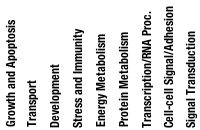
| Probe ID | Name | G | T | D | X | E | P | R | C | S |  |
 |
Description |
| 211160_X_AT | ACTN1 | G | C | |
|
actinin, alpha 1 | |||||||
| 220048_AT | EDAR | G | D | S | |
|
ectodysplasin A receptor | ||||||
| 203166_AT | CFDP1 | G | D | C | |
|
craniofacial development protein 1 | ||||||
| 213786_AT | TAX1BP1 | G | |
|
Tax1 (human T-cell leukemia virus type I) binding protein 1 | ||||||||
| 213581_AT | PDCD2 | G | |
|
programmed cell death 2 | ||||||||
| 218100_S_AT | IFT57 | G | S | |
|
intraflagellar transport 57 homolog (Chlamydomonas) | |||||||
| 203373_AT | SOCS2 | G | S | |
|
suppressor of cytokine signaling 2 | |||||||